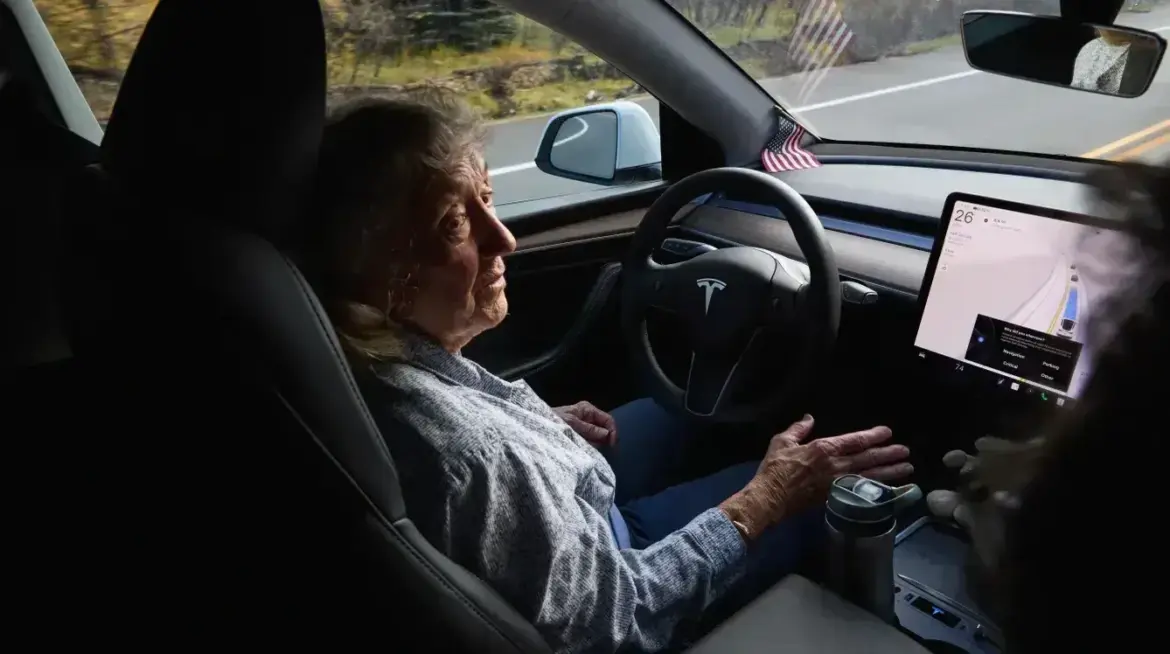
For Joan Spalding, the winding mountain roads leading to her home in Evergreen, Colorado, used to be a source of stress. At 89 years old, she admits that her reflexes weren’t what they once were, a realization that hit home following a serious accident two years ago. Today, however, she navigates those same treacherous cliffs and narrow dirt tracks with a newfound confidence. While sitting behind the wheel of her Tesla Model Y, Spalding rarely touches the pedals or the steering wheel, relying instead on the company’s Full-Self Driving Supervised technology to guide her through the pines.
This shift toward automation is becoming an attractive lifeline for seniors facing the difficult conversation of when to give up their keys. By subscribing to Tesla’s monthly software service, drivers like Spalding feel they have regained a sense of independence and mobility. Her son, Mike, who suggested the car after noticing his mother’s declining driving skills, believes the integrated safety features protect both his mother and everyone else on the road. This sentiment is echoed by others across the country, including 98-year-old Larry Dimmock, whose experience with the technology has been highlighted by Tesla CEO Elon Musk as a prime example of how AI can provide essential accessibility for elderly citizens.
Despite these personal success stories, safety experts warn that trusting an algorithm with a life is not without risk. Bryan Reimer, a research scientist at MIT, argues that there are still significant safety gaps in current automated systems that make him hesitant to recommend them to loved ones. Critics point out that while Tesla claims its system is significantly safer than human drivers, independent verification remains elusive because the company does not release comprehensive data for third party review. There is also a deep concern regarding the branding of Full Self-Driving; though it requires constant supervision, critics argue the name encourages dangerous complacency.
The most pressing worry for researchers like Alexandra Mueller from the Insurance Institute for Highway Safety is whether aging drivers possess the cognitive speed required to intervene during a system failure. Because humans naturally relax when a machine performs well over time, there is a fear that someone with age-related impairments might not react quickly enough when the software encounters an edge case it cannot handle. Regardless of these warnings, millions of users continue to subscribe to these services, finding that for them, the trade-off between theoretical risk and daily freedom is well worth it.